7 Indoor Exercise Games for Dogs That Burn Energy

Last Updated: October 25, 2026
Quick Summary
Indoor exercise games for dogs include hide-and-seek, tug-of-war, scavenger hunts, puzzle toys, obstacle courses, hallway fetch, and stair exercises. Run two or three games per session, mixing one movement game, one scent game, and one training game, since 15 to 20 minutes of mixed play can help settle a dog.
Clear the floor and play on carpet or a mat so your dog has grip.
Fifteen minutes of structured tug-of-war is a real workout for most dogs.
Set up a scavenger hunt in two minutes and your dog works for ten.
Skip stairs entirely for puppies under about a year, seniors, and dogs with back issues.
Keep puppy play to five-minute bursts, several times a day, on carpet rather than tile.
Table of Contents
How to Exercise a Dog Indoors: Safety First
7 Indoor Exercise Games for Dogs That Actually Tire Them Out
1. Hide-and-Seek
2. Tug-of-War
3. Treat or Toy Scavenger Hunt
4. Puzzle Toys and Interactive Feeders
5. Indoor Obstacle Course
6. Fetch in Suitable Spaces
7. Stair Exercises
Brain Games for Dogs: Mental Stimulation That Tires Them Out
Indoor Games for Puppies: Adapting Play for Young Dogs
Rainy Day Activities for Dogs: Structured Exercise Plan
The weekly template
How to build a single session
Progression: how to make the plan harder without adding time
Small-space and low-noise adaptations
Measuring whether the plan is working
Measuring Whether the Game Is Working
When to Call a Professional Dog Walker
Frequently Asked Questions
How to Exercise a Dog Indoors: Safety First
Indoor exercise games for dogs solve a real problem: bad weather, short daylight, and a dog with energy to spare.
Safety comes before fun. A quick check protects joints, floors, and furniture.
Clear the floor: no rugs that slide, no small objects a dog can swallow
Keep play on carpet or a mat for grip
Shorten sessions for flat-faced breeds, seniors, or dogs with joint issues
The ASPCA's dog care guidance recommends matching activity to a dog's age and health, not just its energy level.
Before you design a routine, it helps to know how long a dog should exercise daily.
7 Indoor Exercise Games for Dogs That Actually Tire Them Out
These seven games cover scent work, tug, problem-solving, and movement. Rotate them so your dog stays engaged and no single muscle group gets overworked. Each entry includes a difficulty ladder (easy, harder, hardest) and a small-space, low-noise variant.

Pro Tip Run two or three games per session, not all seven. A common pattern is one movement game, one scent game, and one training game, then rest. Most practitioners find that 15 to 20 minutes of mixed play can help settle a dog.
1. Hide-and-Seek
Hide-and-seek is a recall game disguised as fun. Have your dog sit and stay, hide in another room, then call once. Reward big when they find you.
Easy: Hide behind a door in the same room. Call once.
Harder: Hide in a closet or behind a couch in an adjacent room.
Hardest: Hide silently and let your dog search by scent alone, with no verbal cue.
Ten minutes tires a dog mentally and reinforces commands. In a small apartment, hide behind a shower curtain or under a desk, the search still works because the dog uses its nose, not distance.
Adapt by dog: Puppies and seniors do best with easy hides and carpeted floors.
2. Tug-of-War
Tug-of-war builds muscle and burns energy in a small space. Use a long rope toy and keep it controlled.
Let your dog win sometimes
Stop if tugging gets frantic
Never yank or lift your dog off the floor
Fifteen minutes of structured tug is a real workout for most dogs.
Easy: Short, slow pulls with a pause and a "drop it" every 20 seconds.
Harder: Add a sit or down between rounds.
Hardest: Alternate tug with a quick hide-and-seek so the dog switches between arousal and focus.
Adapt by dog: Skip tug entirely for dogs with neck, back, or dental problems, flat-faced breeds that tire quickly, and puppies under about six months whose adult teeth are still coming in. For apartment play, use a soft fleece tug and keep the dog's feet on a mat to muffle noise.
3. Treat or Toy Scavenger Hunt
A scavenger hunt turns your home into a nose-work course. Hide treats or a favorite toy in boxes, under blankets, or behind chairs.
This is the best low-effort game for busy owners. Set it up in two minutes, and your dog works for ten.
Easy: Hide three treats in plain sight on the floor.
Harder: Hide treats under cups, behind chair legs, or inside a cardboard box.
Hardest: Hide a toy (not food) and require the dog to search by scent across two rooms.
Adapt by dog: Use ordinary portions of your dog's daily food instead of extra treats to keep calories in check.
Watch Out Skip small swallowable items like bottle caps, hair ties, and children's toys. A dog searching by scent will put its mouth on anything it finds.
4. Puzzle Toys and Interactive Feeders
Puzzle toys and interactive feeders make your dog work for dinner, slowing eating and adding mental stimulation. Try a snuffle mat for scatter feeding or a sliding puzzle for problem-solving, and rotate toys weekly so they stay new.
Easy: A snuffle mat or a muffin tin with treats in the cups.
Harder: A sliding puzzle or a treat-dispensing ball.
Hardest: A multi-step puzzle with drawers and levers, or a frozen stuffed toy.
Adapt by dog: Beginners and anxious dogs often give up on a hard puzzle and label it "boring." Start easier than you think and increase difficulty only when your dog solves the current level in under two minutes. Flat-faced breeds do better with snuffle mats and licking mats than with puzzles that require pawing.
5. Indoor Obstacle Course
An obstacle course built from chairs, blankets, boxes, and tunnels turns a hallway into a training ground.
Weave between chair legs
Crawl under a blanket draped between two chairs
Jump over a broom handle set low
Change the layout each time. Novelty is what tires a dog out.
Easy: Three stations, weave, crawl, sit.
Harder: Add a low jump (broom handle on two books) and a "find it" at the end.
Hardest: Time the course and add a stay at each station.
Adapt by dog: Remove the jump for puppies, seniors, and dogs with joint issues; substitute a floor-level tunnel or a weave. In a small apartment, build a two-station course in a hallway and run it three times instead of one long course.
6. Fetch in Suitable Spaces
Fetch works indoors only in the right space: a long hallway or carpeted room, never a tight room with breakables.
Easy: Roll the ball along the floor instead of throwing it.
Harder: Throw short distances and require a sit before the next throw.
Hardest: Alternate fetch with a down-stay between throws.
Adapt by dog: Avoid fetch on tile or hardwood for puppies and seniors, fast turns and sliding stops are the main injury risk. For dogs with mobility concerns, replace fetch with a floor-rolling game or a treat toss that keeps all four feet planted.
7. Stair Exercises
Stair exercises build rear-leg strength, but they are not for every dog. Skip stairs for puppies with growing joints, seniors, or dogs with back problems; one or two controlled trips is plenty for most dogs.
Easy: One trip up, one trip down, on carpeted stairs.
Harder: Two or three trips with a sit at the top.
Hardest: Alternate stairs with a scent game to build focus between efforts.
Adapt by dog: This is the game most often misapplied.
If you want more options, our guide to conditioning exercises for high-energy dogs pairs well with these games.
Game | Best For | Session Length | Watch Out For |
Hide-and-seek | Recall practice | 10 min | Slippery floors |
Tug-of-war | Muscle building | 15 min | Neck or dental issues |
Scavenger hunt | Calm focus | 10 min | Small swallowable items |
Puzzle toys | Mealtime enrichment | 10-15 min | Frustration in beginners |
Obstacle course | Confidence and agility | 15 min | Unstable furniture |
Indoor fetch | Quick energy release | 5-10 min | Breakables in the room |
Stair exercises | Strength | 5 min | Puppies and seniors |
Brain Games for Dogs: Mental Stimulation That Tires Them Out
Brain games for dogs tire a dog faster than running: fifteen minutes of scent work can leave a dog as settled as a longer walk. Thinking burns energy, and nose work, puzzle toys, and training games all demand focus.
American Standard Dog Training
Teach a new command in short bursts
Play "find the treat" under cups
Practice recall between two rooms
A tired mind produces a calmer dog, often the real fix for indoor restlessness.
Indoor Games for Puppies: Adapting Play for Young Dogs
Indoor games for puppies need shorter sessions and softer surfaces. Growing joints should not take repeated jumps or stair work.
Keep puppy play to five-minute bursts, several times a day. Use scent games and gentle tug instead of fetch on hard floors.
Skip stairs and high jumps
Favor carpet over tile
End sessions before your puppy gets wild
Puppies tire quickly and recover fast. Short, frequent play beats one long session.
Rainy Day Activities for Dogs: Structured Exercise Plan
Rainy day activities for dogs work best on a schedule; random play leads to an overtired, overexcited dog by evening. The plan below uses a simple weekly rhythm, two short physical sessions, two scent sessions, two training sessions, and one rest day, with each day's blocks under 20 minutes total.
The weekly template
Day | Morning (10 min) | Midday (15 min) | Evening (10 min) |
Monday | Scent hunt | Tug | Training game |
Tuesday | Puzzle feeder | Obstacle course | Calm chew |
Wednesday | Scent hunt | Fetch (hallway) | Training game |
Thursday | Puzzle feeder | Tug | Calm chew |
Friday | Scent hunt | Obstacle course | Training game |
Saturday | Rest day | Short sniff walk if weather allows | Grooming or calm chew |
Sunday | Scent hunt | Fetch (hallway) | Training game |
This is a starting point, not a prescription: a working-line dog may need two rounds of each block, a senior or flat-faced breed half. The point is the pattern, alternate high-arousal games (tug, fetch) with low-arousal games (scent, puzzles) so the dog's nervous system comes down between efforts.
How to build a single session
A well-built session has three parts:
Warm-up (2 minutes): A slow sniff walk around one room or a few easy sits.
Main block (8 to 12 minutes): One movement game and one scent or puzzle game, with a 30-second pause between them.
Cool-down (2 minutes): A down-stay, a chew, or a slow scatter feed on a mat.
The cool-down is an important part of any exercise session. A dog that goes from tug straight to barking at the window has not been cooled down; it has been left at peak arousal.
Progression: how to make the plan harder without adding time
Do not add minutes to fix a dog that is not tired. Add difficulty instead:
Week 1: Easy hides, short tugs, three-station course.
Week 2: Move hides into a second room; add a sit between tug rounds.
Week 3: Add a silent hide (no verbal cue) and a timed obstacle course.
If your dog solves the current level in under two minutes or loses interest, the level is too easy. If your dog walks away, yawns repeatedly, or refuses the game, the level is too hard.
Small-space and low-noise adaptations
For apartments and shared walls:
Replace fetch with a floor-rolled ball or a treat toss onto a mat.
Use a soft fleece tug instead of a rope that thumps the floor.
Put a rug or mat under the obstacle course to muffle jumps and turns.
Measuring whether the plan is working
You will know the plan is working when your dog settles faster after play, chews less, and holds commands with better focus in the evening. Keep a simple one-week log: note the game, the length, and how your dog behaved for the next hour.
Watch for the three failure signals:
Overstimulation: frantic zooming, hard panting that does not settle in five minutes, or nipping.
Frustration: walking away from a puzzle, barking at the toy, or refusing the next game.
Fatigue: slow responses, lying down mid-game, or stiffness the next morning.
Any of these means the session was too long, too hard, or too high-arousal, adjust the next day rather than pushing through.
Key Takeaway The goal of a structured indoor plan is not to replace outdoor exercise. It is to keep the dog's body and mind working on days when the walk is short, so the dog comes out of the bad-weather stretch calmer rather than wound up.
If your dog still seems restless, the issue may be under-exercise rather than boredom. Our guide to the signs your dog needs more exercise walks through the key signals.
Measuring Whether the Game Is Working
You will know indoor exercise is working when your dog settles faster after play, chews less, and focuses better on commands in the evening. Keep a simple one-week log of the game, the length, and how your dog behaved afterward, patterns show up fast. If your dog still seems restless, the issue may be under-exercise rather than boredom; our guide to the signs your dog needs more exercise walks through the key signals.
When to Call a Professional Dog Walker
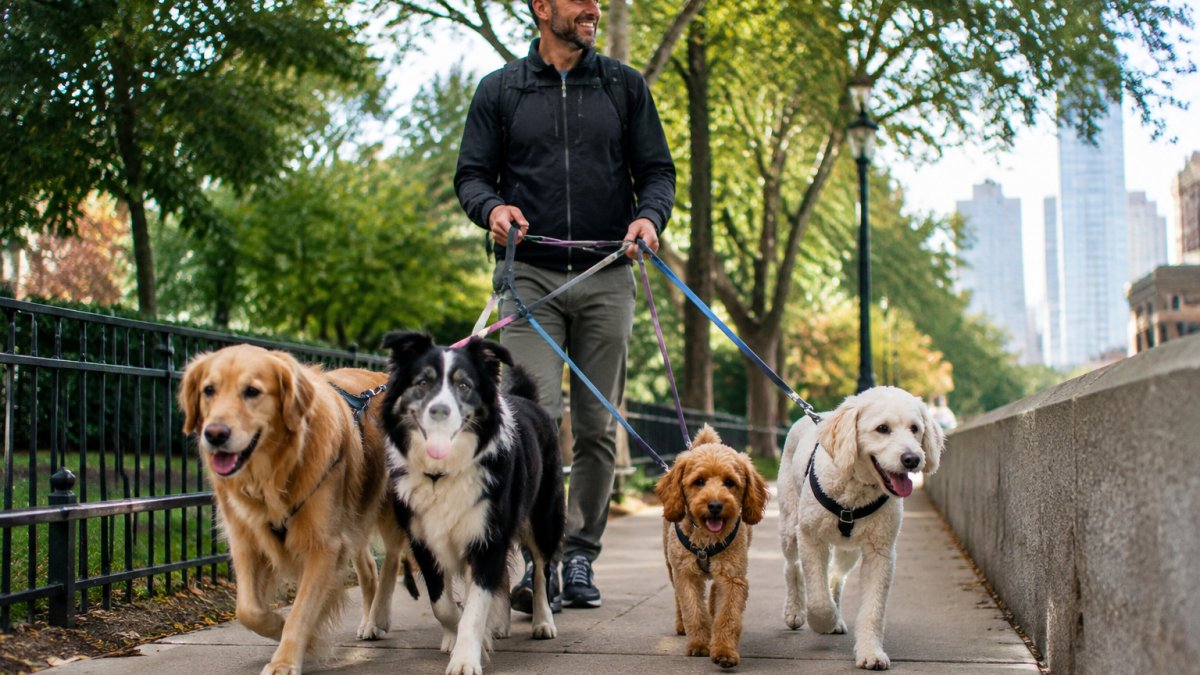
Indoor games help, but some dogs need real outdoor exercise and socialization. A professional walker fills that gap on long workdays or during bad weather stretches.
Bark West provides personalized dog walking for the Park West community, run by Steve the Dog Guy. Every walk is customized to your dog's needs, and we are on call 24/7/365 as a reliable backup. You can review our dog walking service or check plans and pricing before you decide.
Frequently Asked Questions
How long should I play indoor exercise games with my dog?
Keep sessions short, around 5 to 15 minutes, depending on your dog's age and fitness. Puppies and senior dogs do best with 5-minute bursts, while healthy adult dogs can handle 15 minutes of active play. Watch for signs of fatigue like heavy panting or slowing down. Multiple short sessions throughout the day often work better than one long one, and they help prevent boredom without overdoing it.
Can indoor games replace a dog's daily walks?
Indoor games provide mental stimulation and some physical activity, but they rarely match the fresh air, sniffing, and socialization of a walk. Dogs need outdoor time for bathroom breaks and exposure to new sights and sounds. On rainy days or when you're stuck at work, indoor games are a great supplement, but they shouldn't fully replace walks. A professional dog walker can fill that gap when your schedule gets tight.
How can I make indoor games safe for dogs in a small space?
Clear the area of breakable items and electrical cords, and use non-slip rugs on hard floors. Avoid games that involve high jumps or sharp turns on slippery surfaces. For tug-of-war, use a soft toy and avoid pulling up or sideways to protect your dog's neck and teeth. Always supervise play, especially with puzzle toys that have small parts. In apartments, choose low-impact games like scent work or scatter feeding.
What are some brain games for dogs that provide mental stimulation?
Try the muffin tin game: place treats in a muffin tin and cover with tennis balls so your dog has to remove them. Snuffle mats and puzzle feeders also work well. Hide-and-seek with a favorite toy or a family member engages your dog's nose and memory. These brain games for dogs tire them out mentally, which can be just as satisfying as physical exercise, especially for high-energy breeds.
Your dog's energy does not pause for rain, and neither should their routine. Bark West offers flat-rate walks, 24/7/365 on-call availability, and customized care from Steve the Dog Guy. Get started with Bark West and keep your dog moving, even on the days you cannot get home.
Contact
Add bark-west.com as a preferred source on Google →

Comments