Group vs Individual Dog Walks: How to Choose

Table of Contents
Group vs Individual Dog Walks: The Core Trade-Off
Benefits of Solo Dog Walks: One-on-One Attention
Leash Reactivity and Private Sessions
What Group Walks Offer: Socialization and Pack Dynamics
Peer Learning and Mental Stimulation
How to Evaluate a Professional Dog Walker
Dog Walking Duration and Frequency: What Your Dog Actually Needs
A Decision Framework by Dog Profile
Breed-Specific Walking Requirements
The Transition Roadmap Competitors Miss
Cost, Liability, and Insurance: The Practical Side
Liability and Insurance: What Actually Protects You
The Liability Layer Competitors Skip
Transitioning Between Walk Types
Conclusion
Frequently Asked Questions
Last Updated: October 2, 2026
Group vs Individual Dog Walks: The Core Trade-Off
Choosing between group and individual walks comes down to one question: does your dog do better with a predictable routine or a social one? Solo dog walks deliver undivided attention, while group walks build socialization. Bark West, a Park West dog walking service run by Steve the Dog Guy, offers personalized, professional dog walking services.
The right answer often changes by season, by age, and by whatever your dog's week looks like.
The comparison below frames the decision before we dig into each option.
Factor | Individual Walks | Group Walks |
Attention | One-on-one, fully tailored | Shared across the pack |
Socialization | Limited to handler and environment | Constant peer exposure |
Best for | Reactive, anxious, senior dogs | Confident, high-energy dogs |
Scheduling | Flexible, easy to customize | Fixed route and timing |
Cost | Higher per walk | Lower per walk |
Real dogs rarely fit neatly into one column, so let's look at what each format delivers.
Benefits of Solo Dog Walks: One-on-One Attention
The benefits of solo dog walks start with attention: a private walker watches only your dog, so subtle behavioral cues get caught early instead of buried in a crowd.
Private sessions also solve leash reactivity. A reactive dog on a group route rehearses the exact behavior you're trying to fix; on a solo walk, the handler can redirect before the trigger escalates, control distance from other dogs, and keep the pace calm.
Leash Reactivity and Private Sessions
Leash reactivity is a dog's overreaction to triggers while leashed, and it rarely improves in a group setting. Private sessions let a walker manage triggers one at a time, which is why trainers recommend solo routes first.
Reactivity isn't aggression, it's often frustration or fear, and it fades fastest when walks stay predictable. A solo walker can also work on loose-leash skills every outing rather than just managing the pack.
Pro Tip Ask any walker how they handle a dog that lunges at another dog mid-walk. The answer tells you whether they understand reactivity or just tolerate it.
What Group Walks Offer: Socialization and Pack Dynamics
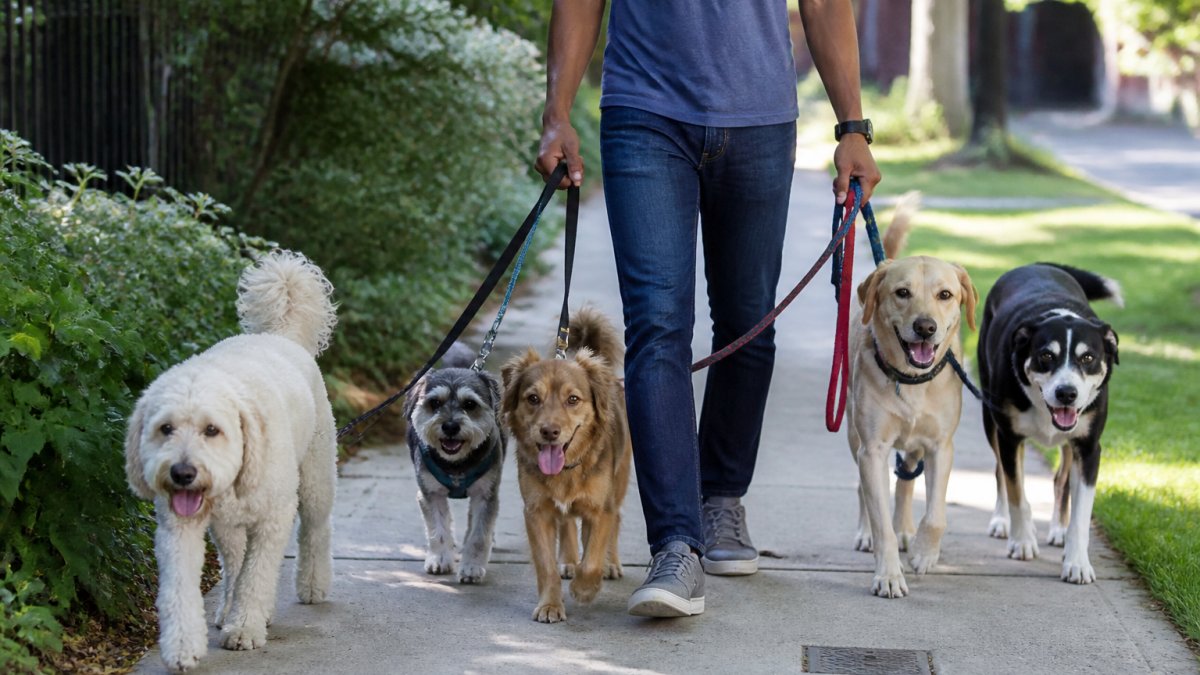
Group walks deliver what solo walks can't: constant socialization and the mental stimulation of reading other dogs. A well-matched group teaches impulse control, and many owners find their dogs calmer at home afterward.
Dogs learn greetings and boundaries from each other, and a skilled walker structures the group so no single dog gets overwhelmed.

Peer Learning and Mental Stimulation
Mental stimulation is the quiet benefit of group walks. Sniffing, greeting, and navigating a pack drains energy in a way pure mileage never does, and tired dogs are usually better-behaved.
The catch: a mismatched group can do the opposite. A shy dog thrown into a boisterous pack learns to shut down. Matching energy levels is the walker's job.
Watch Out Avoid any group that mixes a timid dog with high-drive adolescents on the first outing. The wrong first experience can set socialization back months.
How to Evaluate a Professional Dog Walker
Evaluating a professional dog walker means checking four things: insurance, references, communication, and how they handle your dog's temperament.
Start with a meet-and-greet: a good walker wants to see your dog's behavioral cues firsthand, not just your description. Ask about safety protocols, emergency procedures, and backups when the walker is sick.
Confirm current insurance and bonding
Ask for two or three local references
Watch how they greet your dog
Get the cancellation and backup policy in writing
Confirm they carry a phone on every walk
The best walkers treat a fitness assessment as standard. A short trial walk reveals more than any interview and shows whether your dog's energy needs are actually being met.
Dog Walking Duration and Frequency: What Your Dog Actually Needs
Most adult dogs need 30 to 60 minutes of activity daily, though duration and frequency depend on age, breed, and health. A brisk 30-minute walk covers many dogs; high-energy breeds may need two sessions. The useful version is what happens when you apply it to a specific dog.
A Decision Framework by Dog Profile
Instead of a single number, match the walk format to the profile in front of you:
Profile | Typical Daily Need | Format That Fits | Why |
High-energy puppy (under 1 year) | 2-3 short outings, 15-25 min each | Group, once vaccinated and cleared | Peer play burns energy faster than mileage; short sessions protect growing joints |
Adolescent working breed | 60-90 min, split across two walks | Group for exercise, solo for training | Group handles the physical drain; solo handles the leash manners |
Adult companion breed | 30-45 min | Either | Low drive means format matters less than consistency |
Reactive or anxious dog | 30-45 min, low-traffic routes | Solo | Group exposure rehearses the exact behavior you're fixing |
Senior with joint issues | 2 gentle walks, 15-20 min each | Solo or small, calm group | Shorter and more frequent beats one long push |
Brachycephalic breeds (pugs, bulldogs, Frenchies) | 20-30 min, cool hours only | Solo or small group | Overheating risk rises fast in heat and humidity |
Most "group vs. solo" articles skip this framework, treating the choice as a personality quiz when it's really a scheduling and physiology question.
Breed-Specific Walking Requirements
Breed-specific needs vary more than most owners expect, and the gap between a working breed and a companion breed is wider than the gap between group and solo walks.
Herding and working breeds (border collies, Australian shepherds, huskies) often need vigorous exercise plus a job. A group walk that includes sniffing, direction changes, and social navigation delivers more mental load than a straight-line solo walk of the same length.
Terriers were bred to hunt independently. They often do better with solo walks that let them work a scent trail than with a group that keeps them in formation.
Brachycephalic breeds overheat quickly. Shorter, cooler, lower-intensity walks, often solo, are safer than a mid-day group route.
Giant breeds (Great Danes, mastiffs) need less total mileage than their size suggests, and more joint-friendly pacing. A slow group walk can suit them better than a brisk solo one.
Senior dogs of any breed usually do best on predictable, low-stimulation routes. A calm, well-matched small group can work; a boisterous one will not.
The practical takeaway: match exercise intensity to the dog in front of you, not the breed label. A tired husky and a tired bulldog require different routes, and often different walk formats.
The Transition Roadmap Competitors Miss
The format that fits a dog at eight months is rarely the format that fits at eight years. Plan for the switch:
Puppy to adolescent. Start solo for leash and potty training, then introduce a small, calm group once vaccinations are complete and the dog can be recalled reliably.
Adolescent to adult. If the dog is thriving in a group, keep it. If leash manners have slipped, layer in one solo training walk per week.
Adult to senior. Watch for stiffness after walks. When recovery time lengthens, shorten the walk and consider dropping back to solo or a small, slow group.
Any stage to reactive. If a dog starts reacting on group routes, pull back to solo immediately. Group exposure during a reactivity spike makes the behavior harder to unwind.
A walker who can move your dog between formats without a new contract is worth more than one who's slightly cheaper.
Watch Out Don't judge a walk's value by minutes alone. A 20-minute sniff-heavy walk can tire a dog more than a 45-minute march, because mental work drains energy differently than mileage.
Key Takeaway Pick the format for the dog you have this month, and build in a plan for the dog you'll have next year.
Cost, Liability, and Insurance: The Practical Side
Cost and liability are where the decision gets real. Individual walks cost more because your dog absorbs the full session.
Liability and Insurance: What Actually Protects You
Liability matters as much as price, and the terms get used interchangeably when they shouldn't be.
General liability insurance covers third-party claims, for example, if a walked dog bites a passerby or damages someone's property. This is the policy that protects you as the owner from being the deep pocket.
Bonding covers theft or dishonesty by the walker. It is not the same as insurance, and a walker who says "I'm insured" has not necessarily answered the bonding question.
Veterinary coverage is a separate rider some walkers carry for injuries that happen on the walk. Ask whether it exists and what the per-incident limit is.
Ask directly and get the answer in writing before you book. A walker who hesitates on insurance is telling you something.
The Liability Layer Competitors Skip
Here's the angle most guides miss: in a group walk, your dog's behavior can create liability for other owners' dogs, and theirs for yours. If your dog instigates, you may be exposed even though you weren't present, a real reason to confirm the walker's insurance covers all dogs on the route, not just the one being walked at the moment of an incident.
A practical checklist before you sign anything:
Certificate of insurance (COI) with the policy effective dates
Confirmation of bonding, separate from liability
Written emergency vet protocol and which clinic is used
Whether the walker's policy covers all dogs in a group simultaneously
Your own homeowner's or renter's policy, confirm whether it excludes commercial dog-walking incidents
That last item trips people up: many homeowner's policies exclude injuries from a business arrangement, so the walker's coverage does the heavy lifting. Confirm yours before assuming it's a backstop.
Pro Tip Ask for the COI as a PDF, not a screenshot. Screenshots can be outdated, and the effective dates are the part that matters.
Transitioning Between Walk Types
Transitioning between walk types works best gradually.
The reverse matters too: a dog that's become reactive or injured may need to step back to solo walks temporarily. Flexibility keeps a walking arrangement sustainable as your dog changes.
Key Takeaway The best walking setup isn't permanent. It shifts as your dog ages, heals, and changes, and a good walker plans, and prices, for that.
Conclusion
Every dog owner faces the same tension: you want your dog socialized and exercised, but you also want to know they're safe and cared for. Bark West provides a flat rate of $20 for a 30-minute walk, 24/7/365 on-call availability, and fully insured, bonded service. Steve the Dog Guy customizes every walk to your dog's needs, providing peace of mind while you are at work or away. Reach out to Bark West and give your dog a walk that fits.
Frequently Asked Questions
How do I know if my dog is a good candidate for group walks?
Start with a temperament assessment. Dogs that walk calmly past other dogs, respond to basic cues, and recover quickly from surprises usually do well in a group. Dogs with leash reactivity, resource guarding, or high anxiety around unfamiliar dogs are better candidates for private sessions. A professional dog walker can run a short trial walk to see how your dog handles pack dynamics before committing to a regular group schedule.
Are group walks safer than solo walks for reactive dogs?
No. For a reactive dog, a group walk raises the risk of a trigger stacking up, especially in tight urban environments where you cannot control distance. Solo walks give the walker room to redirect, change route, and keep the dog under threshold. Many reactive dogs do best with one-on-one sessions until behavioral cues improve, then transition to a small, well-matched group if the walker thinks it is safe.
How does the level of supervision differ between group and individual walks?
A solo walk means one walker watching one dog the entire time, which allows for real-time corrections, training reinforcement, and attention to subtle behavioral cues. Group walks split that attention across several dogs, so supervision is more about scanning the whole group than fine-tuning one dog's behavior. If your dog needs tailored attention or is working on specific skills, individual walks deliver more of it per session.
What are the benefits of solo dog walks for an anxious or senior dog?
Solo walks remove the pressure of unfamiliar dogs and unpredictable pack dynamics. An anxious dog gets a predictable route, a consistent pace, and a walker who can read stress signals without distraction. Senior dogs benefit from walks matched to their fitness level, with shorter distances and more sniff breaks. These one-on-one sessions often support stress reduction and help a nervous dog build trust with the walker over time.
How long and how often should my dog be walked?
Most adult dogs need 30 to 60 minutes of walking per day, split into one or two sessions. High-energy breeds and puppies often need more, while seniors and flat-faced breeds may do better with shorter, more frequent outings. Frequency matters as much as duration: a daily 30-minute walk beats two long weekend walks for energy release and routine. Ask your walker to adjust duration based on your dog's fitness assessment and energy level after each session.
What should I ask before hiring a professional dog walker?
Ask about insurance and bonding, how they handle emergencies, whether they use a written service agreement, and how they match dogs for group walks. Request references from clients in your neighborhood and ask how they handle leash reactivity or a dog that gets overwhelmed. A reliable walker will also ask you about your dog's temperament, medical needs, and daily routine before the first walk, and will offer a meet-and-greet so both sides can decide if it is a good fit.
Can my dog switch between group and individual walks?
Yes, and many dogs do well with a mix. A puppy might start with solo walks to build leash skills, then join a small group once those skills hold. A senior dog might shift back to private sessions as energy drops. The key is to watch for changes in behavior after each walk type: if your dog comes home over-aroused, overtired, or skittish after a group walk, that is a signal to reduce group time and increase one-on-one sessions until things settle.
How does cost compare between group and individual walks?
Individual walks cost more because you are paying for one-on-one attention. Pricing depends on walk duration, frequency, and your specific neighborhood. For a flat-rate quote, contact Bark West directly, since rates vary by schedule and service level rather than a single published number.
Contact

Comments