How to Stop a Dog From Lunging at Strangers

Last Updated: November 1, 2026
Quick Summary
To learn how to stop a dog from lunging at strangers, find the distance at which your dog notices a person but can still eat and listen, then work ten feet inside it. Pair every stranger sighting with high-value treats so the dog learns to look at you instead of lunging, and add a body block or treat scatter for close passes.
The lunge is the last step in a stress-signal chain, so catch lip licking or a hard stare early.
Use a front-clip harness or flat collar with a six-foot leash, and skip retractable leashes on reactive walks.
If your dog stops taking treats, you are too close, so add distance until it eats again.
Drill one alternative behavior such as watch me or find it at home before practicing near strangers.
Bring in a certified trainer if reactions worsen despite consistent training or your dog has made contact with a person.
Table of Contents
Why Your Dog Lunges at Strangers on Walks
The lunging isn't defiance. It's a dog doing the only thing it knows when a stranger gets too close. Learning how to stop a dog from lunging at strangers starts with understanding that the behavior is communication, not aggression.
The American Kennel Club's guidance on leash lunging makes a useful distinction. Preventing a dog from practicing the behavior is not the same as changing how the dog feels. Management buys you safety. Training changes the response.
Fear, Frustration, and Overexcitement: Three Very Different Drives
Three drives sit behind most stranger lunging, and they need different plans.
Fear: The dog is scared and wants distance. Ears back, tail tucked, body low.
Frustration: The dog wants to greet the person and can't reach them. Pulling forward, whining, high-pitched barking.
Overexcitement: The dog has poor impulse control and boils over. Jumping, spinning, mouthing the leash.
A fearful dog needs space and slow exposure. A frustrated greeter needs impulse-control work. Mixing up the two wastes months.
Fearful dogs often need confidence work before anything else.
Reading Stress Signals Before the Lunge Happens
The lunge is the last step in a chain, not the first. Watch for the early signs:
Stiff body and a hard stare
Lip licking or yawning when no one is tired
Sudden sniffing of the ground
Catch any of these and you have seconds to create distance. Miss them and you're managing a lunge instead of preventing one.
Safety and Equipment Setup Before You Train
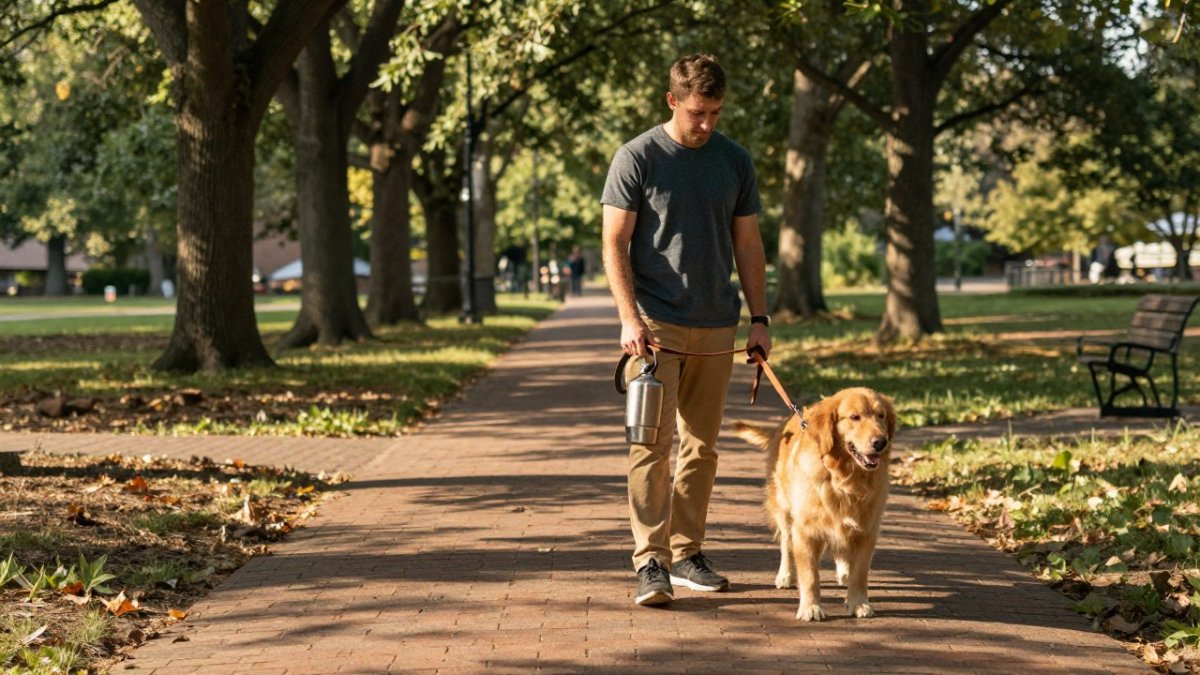
Gear comes first because a failed setup ruins the training. Use a front-clip harness or a well-fitted flat collar, plus a six-foot leash. Skip retractable leashes on reactive walks, since they make it hard to control distance.
A few non-negotiables:
Two points of contact for strong pullers: harness plus collar with a double-ended leash.
High-value treats in a treat pouch you can reach in one second.
A treat magnet on a spoon or squeeze tube for fast licking during trigger passes.
A muzzle is not a punishment and not a sign of failure. If your dog has made contact with a person before, a basket muzzle can help keep everyone safe while you train.
Step 1: Find Your Dog's Threshold and Work Below It
Threshold is the distance at which your dog notices a stranger but can still eat, listen, and think. Find that distance, then work ten feet inside it. If your dog stops taking treats, you're too close.

Here's how to map it:
Pick a quiet spot with good sightlines.
Have a helper stand still at a set distance.
Watch your dog. If it eats treats and looks back at you, add five feet closer.
Repeat until the dog stops eating or fixates. That last distance is the threshold.
Most owners work too close and too fast. Slow down. A dog that succeeds at forty feet today will succeed at thirty feet next week.
Step 2: Counterconditioning and Desensitization for Dogs That React to People
Counterconditioning means pairing the sight of a stranger with something the dog loves, usually food. Desensitization means starting at a distance where the dog stays calm and closing the gap in small steps.
Cesar Millan
The sequence is simple:
Stranger appears at threshold distance.
Treat flows the moment the dog sees them.
Stranger leaves. Treats stop.
Repeat until the dog looks at you when a stranger appears.
That look is the whole game. If you need concrete options to use during threshold work, see these calming treats for reactive dogs on walks.
Step 3: Teach an Alternative Behavior and a Reliable Cue
Give the dog a job to do instead of lunging. The most useful alternative behaviors:
Watch me: dog turns and makes eye contact on cue.
Find it: scatter treats on the ground to break a stare.
Go behind: dog moves behind your legs for a body block.
Pick one cue and drill it at home first. Then practice on quiet streets. Only then bring it near strangers. Repetition and consistency matter more than variety here.
How to Handle Anxious Dogs During Walks With Stranger Scenarios
Anxious dogs need a plan for the moments you can't control. A stranger rounds a corner. Someone reaches out to pet. A jogger appears fast. The generic rules below are the foundation, but the real work is rehearsing the specific scenarios you meet on your route.
The Four Core Moves
Body block: step between your dog and the person, turn your shoulders, and keep moving. Your body becomes the barrier so the dog doesn't have to lunge to create distance.
Create space: cross the street before contact, not after. Anticipate the pass rather than reacting to it.
Speak first: "She's in training, please give us space" works better than a silent tug. Say it early, at a distance, so the person changes course before your dog notices them.
Scenario 1: The Close Pass on a Narrow Sidewalk
This is the hardest everyday test because you can't always cross. Plan the pass before it happens:
Spot the oncoming person at least half a block away.
Move your dog to your far side, away from the passer.
Put a parked car, a hedge, or a planter between you and the person if one is available.
Start a treat scatter ("find it") on the ground two seconds before the person reaches you, so your dog's nose is down during the pass.
Keep walking; don't stop and stare.
If your dog can't eat during the pass, the gap was too small. Next time, step into a driveway or wait behind a parked car until the person passes.
Scenario 2: The Stranger Who Reaches Out to Pet
Well-meaning strangers are a training hazard because they approach fast and reach over the dog's head. Practice a script before you need it:
Step your dog behind you and put your hand up, palm out: "She's not friendly with strangers, please don't pet her."
Don't apologize or over-explain. A short, calm statement moves people along faster than a long story.
Reward your dog for the retreat with a treat the moment you're clear.
If the person keeps reaching, turn and walk away. Your dog's safety outranks a stranger's feelings.
Scenario 3: Delivery Workers and Doorbells
Delivery workers appear suddenly, often at the door, and many dogs who are fine on walks struggle at home. Set up a routine:
Put your dog on a leash or behind a gate before opening the door.
Have a treat scatter ready on the floor a few feet back from the door.
Ask the worker to leave the package and step back before you open the door.
Repeat this on quiet days with a friend playing the delivery worker so the real event is less surprising.
Scenario 4: Children and Crowded Sidewalks
Children move unpredictably and often run toward dogs. Give them a wider berth than adults:
Cross the street for groups with children even if you wouldn't for a single adult.
Use a treat magnet (a spoon or squeeze tube of wet food) to keep your dog's head up and licking during the pass.
Ask parents to keep children back rather than asking the child directly.
Scenario 5: Visitors Entering the Home
Stranger lunging isn't only an outdoor problem. For visitors:
Put your dog in a separate room with a food toy before the guest arrives.
Let the dog out on leash after the guest is seated and quiet.
Have the guest ignore the dog completely; no eye contact, no reaching out.
Dog Leash Reactivity: Stopping the Barking and Lunging Cycle
Barking and lunging feed each other. The dog barks, the stranger moves away, and the dog learns that barking works. Break the loop by rewarding quiet before the bark starts.
How to Stop a Dog From Barking at People
The fix is the same as the lunge fix: distance, reward, repeat. When a stranger appears, feed treats before your dog barks. If the bark starts, add distance until it stops, then reward the quiet. Never scold the bark. Punishment adds stress and often makes the next reaction bigger.
Tracking Progress and Knowing When to Get Professional Help
Progress is slow and uneven, which is why owners quit. The fix is to measure the right things and to know what a setback actually means. Track three measures each week:
Measure | What to Record | Good Sign |
Threshold distance | Feet at which dog stops eating | Shrinking over weeks |
Recovery time | Seconds to refocus after a trigger | Getting shorter |
Reaction intensity | Scale of 1-5 per encounter | Dropping over time |
Observable Milestones to Expect
Most reward-based practitioners describe progress in stages rather than weeks. Expect to see these in roughly this order:
Notices sooner, reacts less. Your dog spots a stranger at the same distance but the reaction is smaller.
Recovers faster. After a reaction, your dog turns back to you in seconds instead of minutes.
Offers the alternative behavior. Your dog looks at you or offers "find it" before you cue it.
Handles closer passes. The distance at which your dog stays calm shrinks by a few feet at a time.
Generalizes. Your dog holds the behavior on new streets, with new people, at different times of day.
If you're not seeing step one after several weeks of consistent work, the training plan needs adjusting, not more repetition.
A Simple Training Log
Keep a notebook or a phone note with one line per encounter:
Date and location
Distance to the stranger in feet
Reaction intensity (1-5)
Review it weekly. Patterns jump out fast: reactions are worse at dusk, worse near the school at pickup, better after a sniff walk. Adjust the plan around the pattern.
Troubleshooting Setbacks
A bad day is not a failed plan. Before you change anything, check these common causes:
Too close, too fast. Drop back ten feet and rebuild.
Trigger stacking. A dog that has already met three strangers, a loud truck, and a squirrel has less bandwidth. Shorten the walk.
Low-value treats. If your dog won't eat, the food isn't good enough for the environment.
When to Bring In a Professional
Bring in a certified trainer or your vet if any of these are true:
Your dog has bitten or made contact with a person.
Reactions are getting worse despite consistent training.
You've plateaued for a month with no measurable change.
Start with your vet to rule out pain or a medical component. Then look for a trainer who uses reward-based methods and has experience with reactivity; credentials from a recognized professional organization are a reasonable filter.
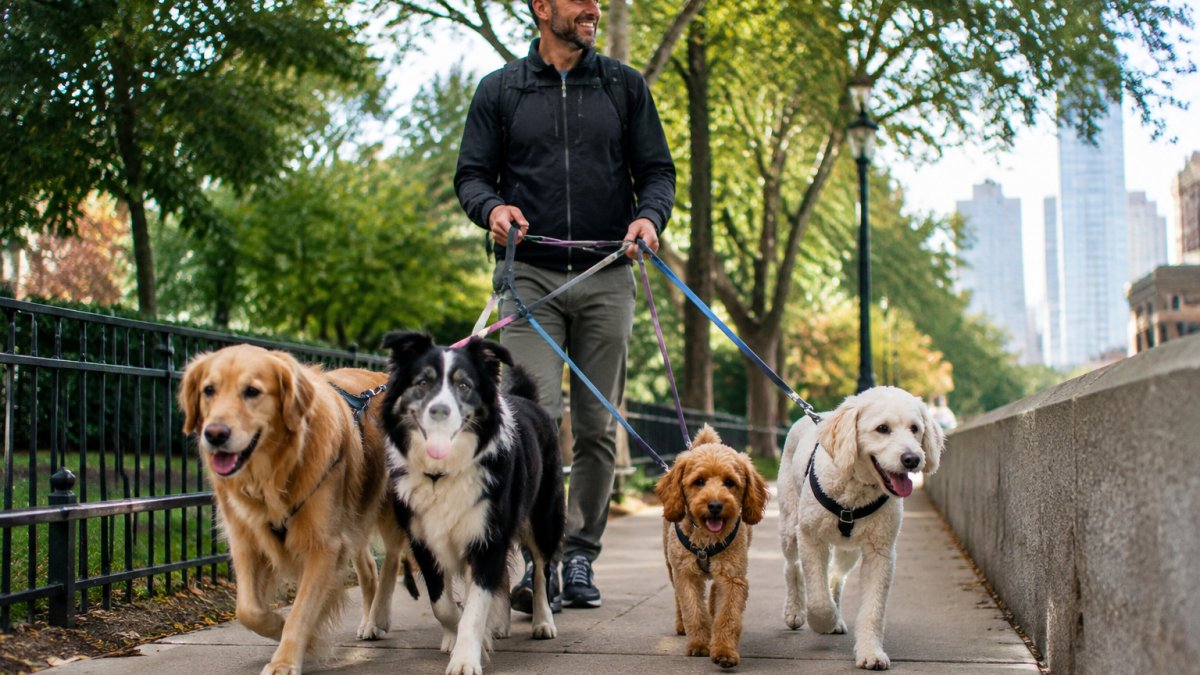
When your schedule makes consistent training hard, a professional walker can help reinforce the plan on outings. For current availability and pricing, check Bark West's website or request a quote.
Frequently Asked Questions
Why does my dog lunge at strangers on walks?
Most dog lunging at strangers comes from one of three drives: fear, frustration, or overexcitement. A fearful dog wants the person to go away, a frustrated dog wants to reach them, and an overexcited dog has never learned to greet calmly. Owners commonly mistake reactivity for aggression. Watch the moments before the lunge, because the body language there tells you which drive you're dealing with and shapes your training plan.
Is it ever too late to train a reactive dog?
No. Older dogs can learn new patterns, though it usually takes more repetition and patience than it would with a young dog. The key is consistency: short sessions several times a week, working below your dog's reaction threshold, and rewarding calm behavior every time it appears. If your dog has a bite history or the behavior is worsening, work with a certified trainer or veterinary behaviorist rather than going it alone.
How do I train my dog not to lunge at other dogs?
The same distance-and-reward framework that works for strangers applies to dog leash reactivity. Find the distance at which your dog notices another dog without reacting, reward calm behavior there, and gradually close the gap over weeks. Side-by-side walking at a comfortable distance helps, as does a U-turn cue when you misjudge the spacing. Never let your dog practice lunging, because every rehearsal makes the pattern stronger.
When should I get professional help for a dog that lunges at people?
Seek help if your dog has made contact with a person, if the lunging is escalating despite consistent training, or if you cannot find any distance where your dog stays calm. A certified trainer or veterinary behaviorist can assess whether fear or anxiety is driving the behavior and build a plan around it. Your veterinarian can also rule out pain or medical issues that make a dog more reactive on leash.
Consistency is what changes a reactive dog, and it's the hardest part to keep when work runs late. Bark West was built for exactly that gap. Steve the Dog Guy walks dogs one at a time, customizes each walk to the dog's needs, and stays on call 24/7/365 as a backup when your day falls apart. Every walk is a flat $20 for 30 minutes, fully insured and bonded. Get started with Bark West and give your dog a calm, steady routine that supports the training you're doing.

Comments